Ramayana [Part 1]: An Amalgamation Bondage
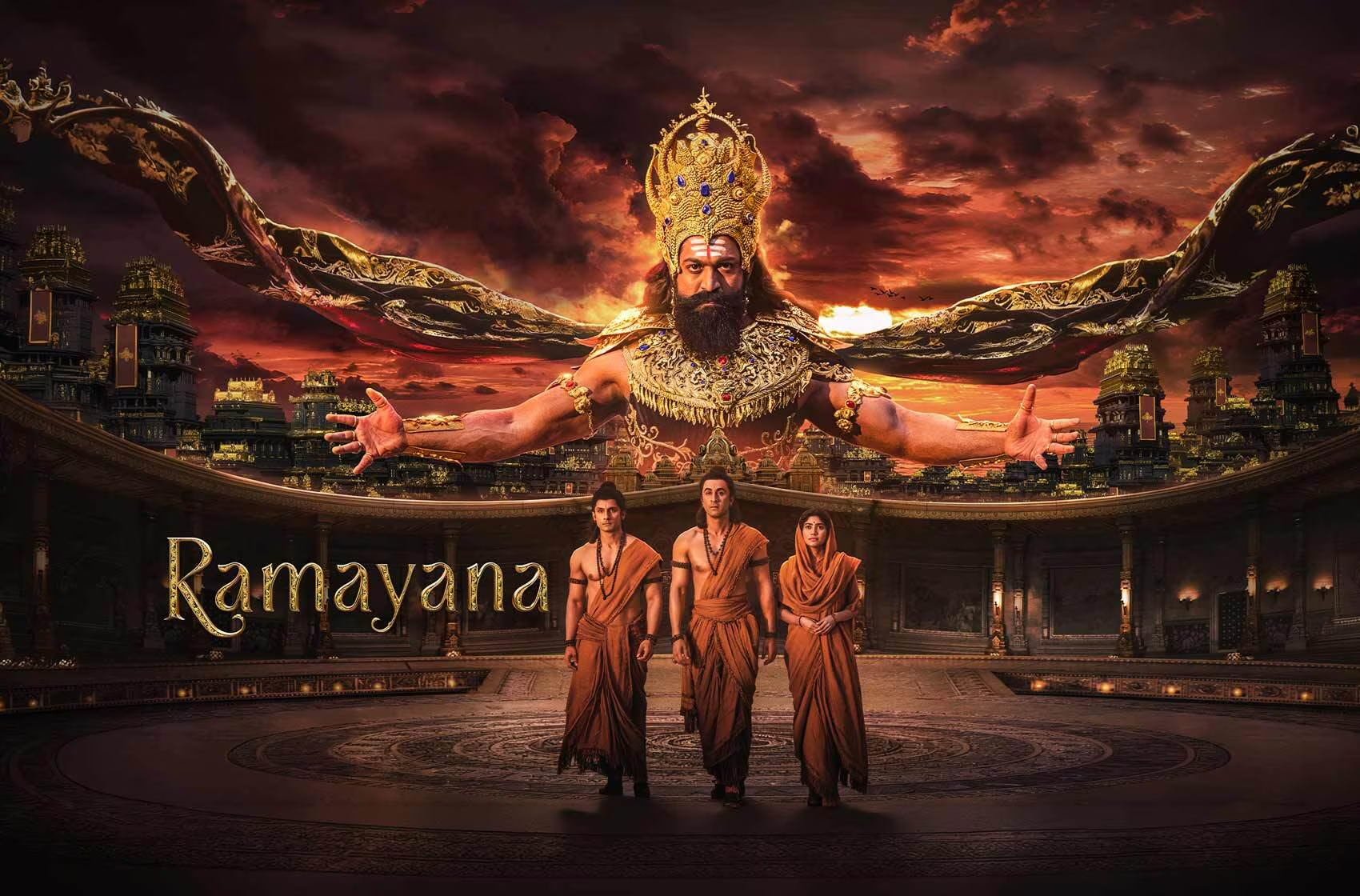
Star Cast: Ranbir Kapoor, Yash, Sai Pallavi, Ravi Dubey, Sunny Deol, Kajal Aggarwal, Rakul Preet Singh.
Music Composed by Hans Zimmer and A.R. Rahman
Cinematography by Pankaj Kumar and Mahesh Limaye
Written by Shridhar Raghavan & Nitesh Tiwari
Edited by Huzefa Lokhandwala
Directed by Nitesh Tiwari
In my reviews, the majority of readers point out and sometimes complain that I consistently draw parallels to the Ramayana and the Mahabharata. Some view it as my USP, while others see it as an obsession. With the epics occupying so much of my headspace, I genuinely wanted to be surprised by this adaptation of the Ramayana, as I truly wanted to see the story told without any deviations and at the level that made my childhood memories so delightful. Sadly, I walked away from the screening DISAPPOINTED. Do I recommend it? The short answer is NO!! Now, allow me to share my long answer with SPOILERS.
Spoilers Ahead: Seriously?? Even Valmiki couldn’t have predicted the cinematic crimes ahead.
There are two ways to experience the Ramayana: devotional and practical. Sage Valmiki started it as Itihasa while also crafting it as sacred devotional poetry, a difficult mixture, yet he mastered it so well that both sides would be happy, making it a long lasting epic. I tried both approaches to understand the nuances with whatever little maturity and immaturity, I possess. If you take the practical approach, a prince named Rama from Ayodhya took on scavengers living in the forests who were dismantling the peace and harmony of the places. Not an urbanisation vs indigenous narrative, but rather a story of the strong using all their might to dominate the weak and capture natural resources in a way, colonisation. Ravana could be called an early coloniser, as he preferred to own every piece of land, with only a few kingdoms being an exception. So, Rama travelled all the way to Ravana’s home turf and won independence for all who suffered, while also freeing his wife. Here, a practical thought process questions: Did Rama actually ask Sita to undergo a purity test? Valmiki’s text says, “Rama asked Sita to choose her own life path, as he could not accept her as his Queen”. (Not as a wife, but as a queen). She then decided to jump into the pyre essentially attempting suicide, which Agni Dev himself stopped, announcing her purity. So, my practical thought process concludes: “The elders might have stopped her, and the extreme step she was willing to take in itself confirmed her loyalty”.
With the devotional approach, I convinced myself that Lord Vishnu descended as Rama and then the story, surprisingly, started feeling more grounded than actual devotional texts. Rama feels so “real” as a person and as a human that the practical approach kept coming back. In short, as they say, winners write history maybe a historical event against a mighty king was remembered as a godly event and practically turned into a “mythological epic” rather than remaining grounded in reality. Homer’s Iliad is seen as an example of such a phenomenon, where “real incidents” can become “supernatural” and “magical” when someone tries to narrate them as a story: an exaggerated version. In the end, I made my peace with both approaches, falling in love with the story and its characters. This means that, whether real or fictional, the values narrated are memorable, relatable and deserve to be practised. So, my goal in watching this movie was to see if it tries to convey those values and focuses on being a solid narrative with all the emotions and ethics intact. Well, it fails to deliver in that aspect.
Also Read: The Odyssey: Polis Katepesen
Why? Dasaratha married a younger woman, hoping to produce a blood heir for his kingdom. So, he promised her and her father that he would make her son the next king. But Rama’s virtues forced Dasaratha to overlook that oath and he even tried to make sure that no one who knew about his boons would question him. He tried to use peer pressure and even the people’s wishes to give Rama the throne. Still, Rama decided to honor his father’s word and walked away into exile. This episode showcases why being Rama is so difficult. When you father is pleading you to kill him if needed, but take the throne and even people are ready to back you, still if you think it is better to follow the honor rather than taking over the Kingdom, that restraint makes him Superhuman not Vishwamitra’s divya astras. This aspect was narrated so lightly that you feel like someone rushed the makers to move on to the next big action set piece rather than focusing on this very core of the story.
The idea behind this film is that Ravana is given an objective by his mother and he goes to the top of the tallest mountain to attain Brahma Gyan and return as all-powerful. On the other hand, Rama, who is extremely powerful, smart and honorable doesn’t know the purpose of his life. So, he moves as destiny commands before finally deciding to take matters into his own hands. Ravana seized his destiny early on and kept forcing Rama to do the same. While this approach should have made this version of the Ramayana fresh, interesting and engaging, it feels more like the makers were aiming for spectacle rather than heart. Because Ravana’s rise allows for spectacle, he gets a detailed origin story. Similarly, because Rama’s Vanavas and the killing of Thadaka offer scope for spectacle, they are prioritized over the growing bond between Rama and Sita and Rama’s monumental choice to leave Ayodhya.
You can notice that as Ravana climbs higher up to find Brahma, Indra who already flies decides to go deep into the ocean to find Lord Vishnu. This is a nod to the Lingodbhava story, where Brahma goes high up to find the peak, while Vishnu goes deep into the earth to find the root. It is also another nod to Varuna evolving into Vishnu across the different mandalas of the Rig Veda. Plainly, it equates to Brahma’s Satya Loka being the topmost realm while Vishnu resides in the Palasamudra, carrying the weight of the universe. But these nuances are lost, as the Devatas are almost introduced as oppressors of Asuras, whereas the original texts portray them as half brothers who fight for their respective mothers honor. One iteration of Ravana’s ascendance tells us that Lord Shiva created Lanka and Kubera ruled it as the god of wealth, before Ravana attacked it to become the richest ruler ever. Here, it becomes the original home of the Asuras, reclaimed by Ravana. In the dialogues, we hear that Ravana has grown arrogant and proud, but until he kills Vidyutjihva, we find no sign of it. Traditionally, Meghanad becomes Indrajit because he defeats Indra in battle, captures him and brings him before his father. Here?
There is no problem with creative liberty, but Sita was not described as a warrior by Valmiki and even in the Kamba Ramayana, she doesn’t wield any weapons, as a mark of respect and trust in Rama. While Rama killed many Rakshasas during his Vanavas, his journey cannot be reduced to the repetitive idea of him being a brand ambassador for a “Go Green” campaign. If he is a human finding his purpose, he cannot instantly cause greenery to return and if he is seen as Vishnu’s avatar, then you cannot skip over the Ahalya and Sage Gautama episode, which proves his divinity. If you want to celebrate his humanity and warmth, you cannot skip over Guha’s story, where he proves he views everyone as equals. Even if you just want to draw parallels between Ravana’s descent into vices and Rama’s ascendance as Maryada Purushottam, these are the defining points, not him running around in forests killing one demon after another. There is no mention of Lakshmana and his wife Urmila nor of their love and her silent acceptance of his duty. When Bharatha almost disowns his mother Kaikeyi, it is Rama who mends the fractured household even from exile, his word acting as law to make Bharatha stand down. Similarly, Shurpanakha tries every trick to intimidate Rama and Sita without getting a single strong scene and Vishwamitra imparting all the divya astras to Rama and Lakshmana is reduced to a passing mention. When so much of the story is glossed over simply for VFX Asuras to die, you just end up feeling suffocated. And Jatayu never reveals where Ravana lives, it is Sampati who tells Hanuman and the Vanaras about Lanka. If Rama already knew he needed to go to Lanka, he would have found a way to reach it immediately, rather than wandering in search of Sita until Hanuman brought him the Chudamani. Lakshmana suspects Bharatha, but that doesn’t mean the scene doesn’t honor their brotherhood. Similarly, Rama offered Tarpana, he did not immerse ashes. Many flaws like these, along with all the other creative liberties, could have been excused had the story been narrated well.
Technically, the movie tries to sell the spectacle, but the limitations are visible in the 3D conversion of several shots and the background enhancements in VFX. The frames are blurry in some places, overly airbrushed in others and fantastic in a few. This lack of consistency makes you wonder: why not shoot in real locations, at least to some extent? Take the shot of a lotus appearing on Rama it just feels undermined, with nothing to follow it up. Without much effort put into writing their romance and a domesticated life for Rama and Sita, we just see them existing around each other. Thirteen years of marriage and there isn’t a single scene that gives their relationship a lived-in feel? I wonder if Hans Zimmer and A.R. Rahman actually scored the film or if they left it to their assistants, as neither of them leaves any impact. The imagination of Nitesh Tiwari is just too basic in places, forcing extraordinary postcards rather than a story. Yash is superb as Ravana, but Ranbir Kapoor, Sai Pallavi and the rest of the “human” cast just feel bland. On the other hand, Shobana is brilliant as Kaikasi, but all the remaining Asuras don’t really leave any impact either. Overall, Ramayana ends up being a bland cocktail of good, bold and bad ideas, with none of them really coming together to deliver a solid iteration of the epic. While Rama went on a quest to find his destiny, we are left on a quest to find the heart and core of the Ramayana as viewers – wondering if the makers reduced the story to an adventure or if their obsession with getting the world to accept an Indian epic made everyone completely forget the true Indian values of the story.
Note: Adipurush tried to make him a mass hero, while this version made him a forest-dweller seeking adventure. Maybe someone will eventually find the right conviction and vision to make it someday with its true heart and soul in place, much like Sampoorna Ramayanam.
Theatrical Trailer:
Recent Comments