The Odyssey: Polis Katepesen
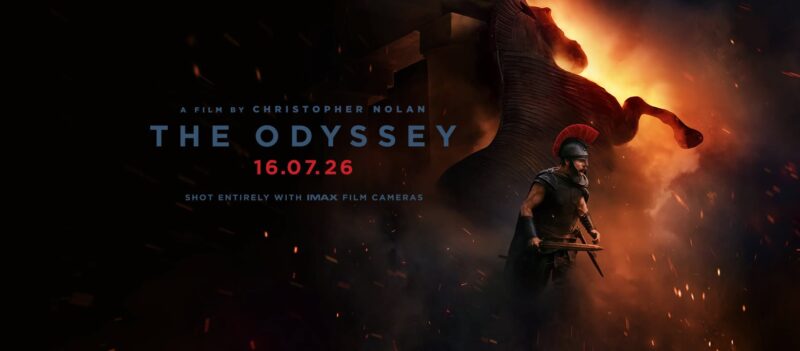
Star Cast: Matt Damon, Tom Holland, Anne Hathaway, Robert Pattinson, Lupita Nyong’o, Zendaya, Charlize Theron
Music Composed by Ludwig Göransson
Cinematography by Hoyte van Hoytema
Edited by Jennifer Lame
Directed by Christopher Nolan
For a non-spoiler context, not to spoil the story, as it is as ancient as the civilization of Greece nor to spoil the experience, my only recommendation is: DO NOT MISS IT. Now, if you have watched it and want to discuss it or read what my take on it is, please continue.
Don’t taste the Lotus, these spoilers ruin the memory.
Christopher Nolan is unique in his ability to turn cinema into a labyrinth. I tried to find an answer internally after watching Odysseus’s journey from the perspective of the master craftsman. I kept telling myself that his films are worthy of an odd Mumbai journey, a rare Bengaluru trip or a ride with friends to different places where they host the best screens for the desirable experience they promise to offer. Why? Why can’t I just watch it like any other film and bask in the glory? Why should I make such trips or even aspire to? People who might know me closely already have an answer and the obvious one would always be passion and love for cinema. I do travel and try to catch the best experience for other filmmakers works too. But when it comes to Nolan, I do take some extra effort and like any other cinephile, I become a student to see what the master is painting like a maze to give us a new context, a new perspective, and a new dimension to understand stories. The answer I was able to find internally is that Adventure.
Yes, movie watching for any individual is subjective, and there is no one objective answer that would be true. A group might showcase similar habits and collectively project an emotion, which can be called passion, but even passion tends to drop after a point where reality is ready to drag us into a whirlpool. We have to sacrifice things like time, family gatherings and memories that could have been made to take such detours from our regular lives to keep up with this bug of passion. There could be a monster who lures with a sheep herd and locks the door to never escape. A bad film and a good film can equally be so intense and immersive that one shows you the door that you pray to open soon, while the other asks you to pray for it to never open. Then there are these highly creative lotuses that beautiful artists offer, where you tend to lose touch with reality and just be happy to share your life and make them a part of your daily routine, like listening to only a particular song. You might feel tied down to witness a great potential being wasted in front of your eyes as the sirens sing. You never know where an adventure leads you, but still, you’re willing to pay the price and that’s nothing but the pure adrenaline rush, the great kick that gravity tends to let you experience.
So, why Nolan? It is not because he cuts across different timelines to give a parallel structure to otherwise straightforward narratives. It is not because he tends to ask you to concentrate on what you are watching, listening and grasping on screen all at the same time. It is not because he is consistent in sticking his neck out to try different complex characters and narratives. It is not because he tends to catch you by the scruff of the neck and look you in the eye. It is because he asks an important question with each one of his stories. Memento [2000] – What if your memories are always your enemy? Insomnia [2002] – What if your obsession lacks objectivity? The Dark Knight trilogy [2012] – Where do your ideologies lead you? Inception [2010] – What is that one dream that never lets you be at peace and is it worth all of it? Interstellar [2014] – Can we learn to respect the present? Dunkirk [2017] – Is survival the only big point in life? Tenet [2020] – Can the travel be more beautiful than the destination and are we missing the point? Oppenheimer [2023] – Does any achievement matter? Now, The Odyssey [2026] – Are we running behind structures and representations that boost our ego rather than harmony? The recent question marks his understanding of a civilization which believed in “Apparent Magic“.
Why do we not believe in it today? Why did previous civilizations believe in and fear them so dearly? Because the purity with which these civilizations began to coexist was replaced by “EGO“. Yes, it all comes down to one simple emotion. Why should I let gods dictate my path? Odysseus, from Nolan’s perspective, asked this question and found out that honor doesn’t lie in sacrifice, glory and destruction, but in prevention, invention and conservation. This might sound “woke”, but it is the most existential need for any person who has ever lived or is going to live. Just think about it: many mythological epics in Indian literature talk about “Naa Aham Karta Daivam Karta” and then also say, “Aham Brahmasmi“, which means God is making me do the deed and then, I am the Creator. Why? Not because such a contradiction is great to exist, but because it is the way of giving up on the ego. When you take responsibility for your deeds and then tell God, “You are my guiding light“, you are not contradicting, you are just living. Just being. Just… It takes guts to accept that you are causing all the misery, all the pain, all the glory, all the happiness and all the frustration without letting the ego take over and attribute it all to the Almighty. Hence, it is hard to understand how gods communicate. Many ideas state that our conscience is God’s voice and look how Nolan uses it to talk about Odysseus’s reluctance to accept the inevitable.
Don’t look for Gods in man, you’ll be disappointed.
His men are no saints. They won a war, but they committed sins in the throes of rage. His men followed orders: suffering on the beach, sailing harsh seas and fighting a never ending war for ten years. But isn’t the city they are so proud to destroy, aren’t the women they are so eager to disrobe and aren’t the men they are eager to slaughter also human? Does a civilization exist because of one man’s leadership or a collective human evolution? Also, Helen is a symbol of radiance, not a skin tone. “Leukos” is the word used by Homer and you can search for its true meaning. Nolan is not trying to tell the story of a few Greeks in the way many imagine Greek mythology to be. It is fair to interpret it as if only Greeks existed in their “civilization”, but is that true? I don’t want to give a lesson here, but a basic search regarding civilizations shows that many co-existed, with trade being the foundation of their economies. When desire leads you to build bridges and cross impossible distances, it should be to exchange harmony, not to des-“Troy” [sorry for the pun]. This film is not just about a great war that happened thousands of years ago, nor is it about whether Nolan can make a historical epic. It is about a human learning to overcome the hurdles thrown by his own desires to understand how nature allows us to lead a life without challenging it. As humans, we try to challenge nature and in doing so, lose the hope of establishing a harmonious tomorrow.
Nolan brings a unique voice to the character of Eurylochus, as well as a delightful twist to Athena. His intention is clear: gods don’t want destruction, they urge you to find a stronger bond as a united force. He uses Athena as a figment of Odysseus’s imagination who follows him and becomes his conscience. Just as many believe that God’s voice is our conscience, we see a beautiful connection to the way an idol and a young woman are slaughtered. It is his guilt that takes shape and voices his concerns and his frustration, helping to keep him sane when brutal, unrelenting forces pressure him to surrender to the mighty. Eurylochus represents the other side of the spectrum, he is always trying to take the easy route out and second guessing whether things are moving in the right direction. If you observe, except for Odysseus, none of them try to hold on to the last tiny bit of conscience because they view war as the ultimate triumph. They want to celebrate it, but when the time comes, Eurylochus is the one who urges Odysseus to stop fighting the gods and surrender. But the point is not to surrender, it is to trust. Not in gods, but in nature.
Technically, Nolan yet again delivers on the promise of craftsmanship. You get the sweeping landscape visuals. You get the harsh sea waves. You get the gigantic creatures. You get to hear the sirens in Ludwig Göransson’s score. Yet your heart doesn’t want to pop out but internalise the experience. The point of any art form is to inspire and let you aspire to understand it from a point of view that is unique to yours. Here, Homer might have crafted a resilient journey, but Nolan saw the curses as horrors and he showcased what we normally perceive as obstacles. It is not about resilience, it is about not submitting ourselves to nature and trusting it enough to let us breathe in its warmth. Matt Damon, Robert Pattinson, Tom Holland and Anne Hathaway nail their parts with such precision that we end up feeling for them and with them. The Odyssey is a great journey for sure, but it is not just a spectacle that demands your attention, it is a spectacle that demands you to internalise the emotion and find that adventurer within you who is afraid to seek new shores of wisdom beyond what the “comfort” of blue lotuses offers.
Theatrical Trailer:
DesTroy loved it bro