Sing Geetham: Eternal Flame of Obsession
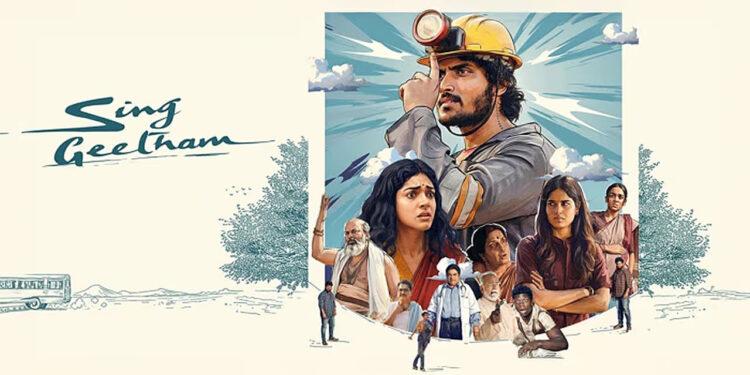
Star Cast: Ahilya Bamroo, Ayaan, Shalini Kondepudi, Sivannarayana, Banerjee, Tulasi Shivamani, Agu Stanley Chiedozie
Music Composed by Devi Sri Prasad
Cinematography by Ankur C
Directed by Singeetham Srinivasa Rao
A scene in Mayabazaar:
Lakshmana Kumara‘s Assistant: “Nenevarino Telusa … Lakshmana Kumarudi Snehitudni … Naaku thalpam isthara thalpam … Gilpam kavali”.
Chinmaya‘s assistants Lambu and Jambu: “Oho emi bootu emi bootu … emi teetha.. emi teetha”
Chinmaya: “Usshuu .. teesthaam teesthaam Gilpame teesthaam!”
Hope it refreshed your memory, if not watch it again. You can come back later.
Incidentally, Singeetham Srinivasa Rao worked as an assistant director for Mayabazaar. He developed an attitude where he became Chinmaya, the role played by Ramana Reddy, who made everything happen with a simple question: “Why not?”. Why can’t there be a mookie film – without dialogues – when talkies are becoming difficult to produce with innovation? Why should we not make a film on Sudha Chandran – who lost her leg but practiced dancing with a wooden leg? (Yes, he made Mayuri long before Peddi.) Why can’t a dwarf, a blind man, or a time machine be heroes? Yes, in Aditya 369, Balakrishna is the leading man, but the story revolves around the time machine. Why shouldn’t there be quadruplets? Why shouldn’t there be folklore? Why not make Mrs. Doubtfire in Telugu?
See how many questions he asked himself and gave us films we can forever be grateful for. Did he only believe in unique premises to yield great films? Watch Panthulamma, Sommokadidi Sokokadidi, Kannada films with Rajkumar, Magalir Mattum, Mumbai Express, Kadhala Kadhala—he is a master in narrating emotions. He also made animation films – Son of Aladdin and Ghatothkach (an animated version of Mayabazaar). Even KS Ravikumar stated that he thought Dasavatharam was a movie to be directed by Singeetham for Kamal, not him. So even legends believed that an innovative idea could be made properly only by this man – a narrative legend.
Why should I list out his films or achievements when I can just talk about Sing Geetham? I just wanted to tell you why only he could have made this film and why he deserved to make it even at 94 years of age.
With all that said, let me be as blunt as I can be. While he made many films that became classics exploring the oddness and novelty in the premise, Sing Geetham did not have similar sharpness and longevity. So, should it not be watched? Definitely not!! Can we watch it? My recommendation would be to give it a try without any hesitation, but do not expect a Welcome to Sajjanpur-kind of clever and engaging narrative that Shyam Benegal pulled off in a rural film at the fag end of his career.
Had Singeetham made it in the 1980s when he conceived it, he would have given us a classic musical. For now, as an attempt that fills the hearts of true movie lovers with about 60% fulfillment of watching a committed narrative, you can watch it. This is not a film made for the twists and turns in the story, but those who want to experience it might feel like the upcoming discussion is “Spoiling Fun”.
Entering Kuberapuram Please Don’t Anger Gods and Step on Plants
The biggest X-factor of Singeetham’s experiment is not the premise but how the situations make it believable with each screenplay beat. In Pushpak, he wrote a screenplay where characters want to speak but they cannot. In Amavasya Chandrudu / Raja Paarvai, he did not go beyond what a blind man could detect and solve. Here, if we expect such a clever integration of premise into the story, it goes into Brundhavanam and Aditya 369 territory. Had a time machine existed and the hero or scientist repaired it to use for solving a crime, but things went haywire? In a way, the story of the film tries to be the same, but it revolves around its necessity only in the final moments, while it could have been established from the first frame. In Brundhavanam, revenge takes the story in a new direction, but it doesn’t happen from the first beat. Pushpak, Michael Madana Kama Raju and Apoorva Sagodhargal start with the story beat from the very first frame. Sing Geetham doesn’t start with a village where a curse is already lurking upon them, instead it takes its own time to set things up.
Is this an issue? Here, if a father ran away to save his child from the curse of talking in songs and then his selfishness somehow landed him on the cursed land, the story would have been interesting from the first beat. He cannot enter this land due to all transport being cut off, but he can sell it off and make huge money. The villagers don’t know why they are cursed and mining becomes impossible. He changes every rule and now he needs to correct it. He thinks he has done it and then the final worsening of the curse happens. I am not writing a story I want to see, it is the story he had in his mind. I am just readjusting a few plot points to see if the premise doesn’t appear like a gimmick but an existing reality into which we are pushed. Knowing that these people are “people” and seeing the curse and then the progress made it more predictable and less consistent. The problem doesn’t lie in the ambition, it lies in spending too much time explaining every character and establishing their arcs, which after a point end up being predictable. So, I am trying to make my adjustments to the screenplay to avoid that.
The most important thing in this film is that it exists as a meta-reference hub created by the people who love him and genuinely wanted to give Singeetham a tribute. There is a hero distributing papers while wearing a Pushpak T-shirt – while it is a reference, it also means he is giving them wings to fly away from the curse. At the top of the cave, a mongoose statue is built up like in The Lion King and Arabian Nights. Also, story-wise the mongoose, representative of nature, gets a far higher position than the idol of God. Aditya 369 song for Vijay Deverakonda’s cameo and the flashback story with a time machine T-shirt, tree and inner cave design resembles Pathalabhairavi-style designing. Twins run Ramudu and Bheemudu ration shops while always being at war. Bhairavadweepam-style old woman waits to break the curse and the 70s and 80s-style climax troupe ofreacting against God. Brundhavanam-style romance starts with a fight before attraction takes over. There is also a callback to Michael Madana Kama Raju with the Anudeep KV Subba Rao scene. And if you notice, Pushpak ends with the hero losing the number of his girlfriend in a gutter, while Sing Geetham starts with the hero jumping into a gutter to find his fortune.
There are many such intricate symbolisms: A lonely tree in once a Green dominated forest land amidst arid surroundings. A lonely sparrow nest with few more eggs. Old mines being abandoned and bombs not being used as the area is “sensitive”. A strong capitalism vs socialism ideology debate – if only one person should own 99 acres or entire village. Mongoose – the representative of nature is the real God not the made-up idol. A tree trunk that resembles mother’s womb. Even the main characters in the story end up being the ultimate loners hoping to be accepted by their parents and society. Pratap is a forced loner as an orphan. Gauri is misunderstood even by her own father. Renu wants her father to appreciate her for once. So, they have their own selfish reasons to use nature and hence, even Gauri did not immediately get a noble solution or escape the curse. It could’ve easily been like Jamba Lakidi Pamba where all character actors go through the curse for hero, heroine and villain to take advantage of and then find solutions. Everyone becomes part of the curse because no one is noble, not even the person who appears to be the purest.
Gauri hides the truth fearing wrath of the village. Her motive might not be as selfish as other two, but she is not pure too. It boils down to a new born to bring a change in entire village as that innocence is hard to find or protect. Even God cannot resist and protest against it. Singeetham uses The Golden Touch story reference, Bhasmasura Hashtam reference, Kubera’s curse premise and most prominently The Last Lear premise and on top of it Aral Sea (Lake) desertification as once thought of as a sea connecting lands falling prey for greed of humans. If you read about Phosphate Mining curse in Nauru – an island nation and Maldives struggle with drinking water, Singapore dependency on neighbouring nations for water and most importantly Sri Lankan dependency on imports, you would be understanding the real heart behind Sing Geetham. Mostly, it feels like Aral Sea aridness has given him the idea as visuals tend to resemble isolated aridity that is rare in Indian landscape as 60-65% grass lands do survive in what appears to be once a dense forest. This ecological anxiety is not distant, India itself mirrors it. The Hasdeo Jungle in Chhattisgarh, threatened by coal mining projects, shows how greed erodes biodiversity and indigenous life. Similarly, the Great Nicobar Project reflects how modern expansion risks ecological destruction and the displacement of tribal populations.
To make visuals more prominent, he might have gone for extremes at places with these climatic changes, but I can see why Nag Ashwin connected with it as he based his entire Kalki Universe on this climatic crisis. The problem lies in scenes getting repetitive after curse is imposed, the predictability in flow and fun premise appearing as a gimmick since the stakes of conversing in songs is reduced by the film itself after a point. Hence, my point of curse being imposed for years and land being cut off from outside communication arises. The characters don’t really have the emotional grip and Singeetham needed actors like Kamal Haasan who could fill the gaps, bring subtext that is missing in lines through their performances for this to grow beyond the surface level points being placed everywhere. Devi Sri Prasad did give his best but even more imaginative composer might have taken it to next level. Still, even though it doesn’t have sing-along quality, the attempt does have a heart and soul bound in it. The technique is strong, performances are good enough and everyone gave their best. Only thing it missed out on is the innovation not coming through from first frame asking us to adapt to the new surroundings. There are brilliant touches like first rain after years comes as a blessing as new thought is born. Gold is represented as object of pride and possession that brings satanic curse with it. Narakasura is son of Vishnu and Bhoomata but he ended up as a human sacrificer and most ruthless evil. Pratap’s arc starts as Narakasura and ends up with him becoming Prahlada, who devotes himself to rightness killing the demon inside. While we all went in to the cave of Singeetham hoping to find the gold from this new mine like in his old ones, we end up just touring around them rather than really being amazed by the experience. Like Eternal Flame of Obsession, he gets to burn to bring something unique. While I salute his ambition, being equally obsessed with greatness that his potential allows, we tend to end up half-satisfied, half-amazed, half-hungry and half-cracked like Kubera idol. Maybe glass can always be half-full, but when there is a river flowing with huge volume of water you can’t fill just half a glass and be happy.
All said and done Hai Hai Nayaka … Singeetha Samrata … Teesuko oka veerathaadu!!
Theatrical Trailer:
Recent Comments