DC: Delusional Cermet
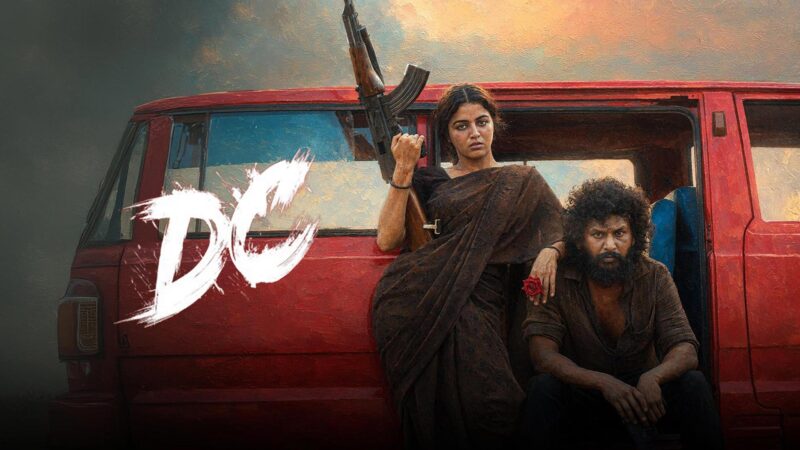
Star Cast: Lokesh Kanagaraj, Wamiqa Gabbi, Sanjana Krishnamoorthy
Music Composed by Anirudh Ravichander
Cinematography by Mukesh G
Edited by G K Prasanna
Directed by Arun Matheswaran
Numerous interpretations of Devadas character exist, but one of my friends told me he finds Devdas to be an incompetent and soulless character in short, a coward. I disagreed with that perspective, but remembered the points: as a character, he does come across as a person who self-destructed out of obsession more than sacrificial love. But the new adaptation appears to be a Cermet – an amalgamation of ceramic and metal in a way, a metal polymer composite. An explanation would require me to dive into spoilers. So, before finding those guns and roses, my short, one line review is: watch it if you don’t mind gore and if you love an artistic adaptation.
This review cuts deeper than an Arun Matheswaran action cut…
Chapter 1: The Human Connection
Normally, we tend to find films clinging on to cliches to explore a human connection. As you try to explore more and more, each one tends to become a cliche for that season or for that genre or for that writer or for that director. They become a signature and some grow over time while many end up being imitations. In my humble opinion, in whatever way a particular writer wants to explore their ideas, they should be given that freedom to see if it clicks in that world they have specifically created. Arun Matheswaran excels in conveying the human connection and attraction through make-up and artificiality, only to later let them open up. The first meet up scene between Parvathy and Devadas showcases Parvathy wearing a black saree, like she regularly does, but sans the lipstick. She trusts him enough to show her true self, yet she doesn’t want to lose that identity which made him notice her. She doesn’t know if he lusts after her beauty or tries to love her soul. So, taking a chance, she comes as both. But when it comes to Chandra, she only has a plastic and made up body that is designed for lust to offer. Hence, she appears in a similar fashion to him.
See how both women connect with him, only as strangers. He doesn’t want to trouble them. He just wants to share a moment, not build a life. Still, he ends up being the reason for one losing her life and the other finding the courage to build one. Parvathy knows that life beyond the bar exists, but cannot move on, while Chandra can only wish. He handed freedom to both. In a cruel twist of events – the one who normally should be associated with finding freedom in death finds sunshine beyond confined four walls, while the other who is educating herself to transition into those brighter fields gets confined to four walls and death. Yes, it is that twisted. See the background of grey for Parvathy and blue for Chandra when they see Devadas in action. He intends only good for both of them, but violence only leads to either obsession or death in this world. Chandra – the moon got her sun to shine, while Parvathy got to meet her Rudra or Kaala – a form of Shiva.
Chapter 2: Stranger’s New Life
Arun is comfortable telling audiences that familiarity is overrated while strangeness is liberating. Yes, for people betrayed by trust, it is hard to find it again and give it a chance. Hence, this stranger who only creates havoc feels more trustworthy, as there is no pretense or judgment. He is not looking at a bar singer and making a move because she would be easy. He doesn’t even cross her doorstep, as his world would destroy hers and he knows that distance is the best thing he can offer. But with a sex worker, he can offer more than that, so he meets her inside her world. This stranger has the capacity to be genuine and this radical rebel has a warmth that civilized regulars can never possess. Arun plays with such visual stimuli to showcase how to read these characters and their motivations. He gives them enough time to register, but he is quick to find that one bullet which can destroy everything. At times, he makes us wish for that barrage of bullets to settle down and never be fired. And in a few portions, he makes us wish for them to fire earlier than they actually did.
Black holes swallow everything and in this world, survival absorbs everything. If you are willing to survive, you’re willing to pay the penalty for even remotely harboring hope. So, is hope wrong in this world? No, the lack of it is. Look at the father scene: he is repairing a spoiled motor wire, but is unable to repair his thought process to hope for his son to be a good guy. He just thinks he is violent and a criminal. It is a conditioned thought that needs you to break out and just look at humans as humans. Devdas feels he cannot welcome love, while Chandra thinks he cannot accept her because of her past. Only when they express what their last ounce of hope really hangs on are they able to find each other. She is accustomed to looking at herself as a plastic rose, as all her life has been sucked out to somehow make her just an object of desire. Real roses have thorns and won’t last more than a day. But a plastic one? Well, it might last a few more days, but what’s the use of a lifeless object other than its being a showpiece? Even a mobile needs charging to be alive, but can a plastic rose ever come to life? A gun can only fire bullets, can it ever give life a second chance? In this black hole of existence, where a soul gets spaghettified, only destructive “showpieces” sans any soul can exhibit a soul.
When an old classic is adapted into a different style, what do you hope it will be? A fusion of old school and new age thoughts. Anirudh Ravichander understood this assignment perfectly. He fuses ragas, club jazz and old school classical tones with new age instrumentation. You’re left wondering how this fusion can infuse life into a subtext that is otherwise lost. Look at how the “Jaya Jaya Shankara” track is used during a ruckus, almost like this violence is an offering. “Raga of Madness” moves to the rhythm, Devadas and his gang move to the rhythm of the newly freed Chandra. “Thaalam Trip” is a very ambitious fusion and it finds its place during a wedding. See, a union is also a fusion and the guitar riffs are gold on top of it. “Hangova” could be the truest song placed in this entire film filled with soundtracks. It is more about how Parvathy is becoming Devadas’s bad hangover. And “Raga of Revenge” finds its best place in the interval and final portions. Perfect placement and each beat elevates the intensity.
We see Chandra wearing a saree and stylish specs, not just to flex style, but as a statement that she is free to do whatever she wishes. The helpless girl who was used to make videos, whose flesh became a high trade, whose heart never really mattered, is finally left to be her heartful self. When everyone decided to throw her into a corner, an unlikely rebel gave her the right to be herself. Hence, she never wants to leave his side and this is not about being grateful or not knowing the outside world, but is more about her heart saying, “Now, I have a reason to beat“. Look at the framing that represents all of it. Devadas first notices Parvathy from high ground, which is perceived to be “safe”, while she is performing. Her voice establishes the connection and their first meeting is literally “mirroring” their true selves.
Look at the handheld frame of Chandra running toward Devadas after stabbing Chunnilal. She never fears him, but only fears losing her Dev – the sun. Astrophysics says that the Moon is moving away from Earth’s gravity step by step, but can it ever escape the Sun’s pull, which, even from a billion miles away, never leaves its side? The Earth is about living, the Sun is about expressing and the Moon is about survival. Now, see how Arun frames these important moments. Until she is told that she is truly free, Chandra never believes it. So, she is not running at the first chance, but is trying to understand what the chaos is all about. He frames her and Devadas in the center third, while filling the outer two-thirds on either side with doors. More than fear, it again showcases the comfort of darkness over the boldness of brightness.
You might be wondering, “Did this guy just find a book called “101 Ways to Like DC”? No, the “madness meets madness” indication, with its Bonnie and Clyde parallel, did excite me, but then the downward spiral became inevitable. You see every encounter Devadas has with any human to end as a lead for him to be caught by the police. You see every person constantly talking about escaping, while no one is really planning what the “real escape” is. You feel like the investigation is too convenient, as the police seem to have everyone, with both good and malicious intent, existing only to help them. Arun did want to convey that family is a strength, as Devadas finds Chandra, reconciles with his father and even lets Kitty find his “real safe haven” – all because they are “a family”. But this idea doesn’t come across as effectively as the potential it presents. Arun’s script always rushes to find a shortcut, having a gun dodge a bullet and a sword cut some skin, a limb or something. Holding them back a little would have helped the madness to really be mad.
Lokesh Kanagaraj is good at expressing through his eyes. He knows his potential and hence, he doesn’t try to stretch himself too much. Wamiqa Gabbi felt like she went too melodramatic in her portrayal. Sanjana Krishnamoorthy is just beautiful and perfect. In fact, she deserved more screen time. Overall, the movie gets 16 out of 20 things it attempts to do right and the remaining 4 stick out like a sore thumb. You hope for the other fingers to be sufficient, but you cannot ignore a thumb that is present just because you want to and just go ahead with the other fingers. It’s not about being accustomed to something, but is more about realizing the potential of a useful bone and really using it. A naturally made amalgamation can be more surprising than a man made one. But this time, a man made, forced cermet is more natural than any other. But in trying to make this amalgamation work, Arun dives into the delusion that only guns and bullets can protect roses, without giving himself a chance to spend that extra moment with the roses – killing the potential for it to be a bloody tribute to a classic that finds its way to inspire generations with its themes. Still, it is a fun film to indulge in and treat yourself to.
Theatrical Trailer:
Recent Comments