Andhra King Taluka: Placebo Ineffectiveness
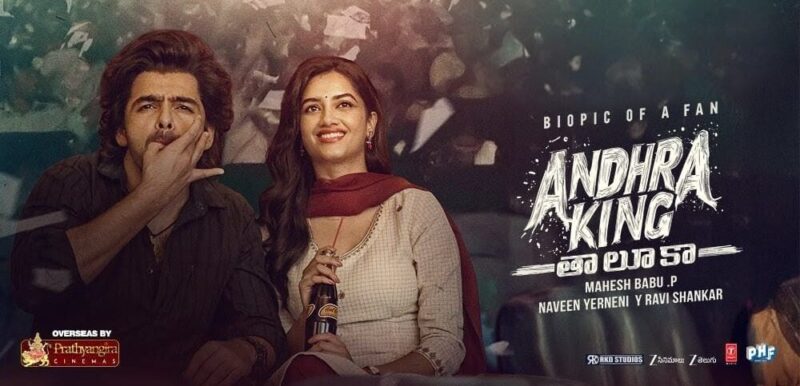
Star Cast: Upendra, Ram Pothineni, Bhagyashri Borse, Rao Ramesh, Murali Sharma, and Satya
Music Composed by Vivek – Mervin
Cinematography by Siddhartha Nuni & George C. Williams
Editing by A Sreekar Prasad
Directed by Mahesh Babu Pachigolla
There is a film by name Arunachalam [1997], where the hero is given a challenge to spend 30 crores in a month to get Rs.3000 crores. I struggled to understand the logic behind it until I watched Baahubali [2015] and RRR [2022]. Spend 450 crores and earn 2250 crores… but then spend Rs.550 crores and only to earn an Oscar award for a song with marginal profits. I understood that if you spend 30 crores in 30 days, you try to do everything possible with the money rather than making it. You realize how easy it is to lose, so you understand how tough it was to make Rs.3000 crores and will try to be careful. But when a success like Baahubali happens, you start to believe in yourself more than required and lose objectivity. In my opinion, RRR did not need that huge budget as reported, no matter at what scale we imagine. Fine, what does it all have to do with Andhra King Taluka? Similar logic applies to scripting as well. Rajkumar Hirani and Imtiaz Ali could not repeat the liveliness and greatness of their writing in 3 Idiots [2009] and Love Aaj Kal [2009] in their next films. I would have used Rockstar [2011], but Nargis Fakhri damaged it so much that the greatness in the writing is overshadowed by her portrayal by miles. See, Rockstar, Tamasha, Sanju, and Dunki are from these modern-day greats, but can you really say that every portion, every scene is enjoyable in these films? The makers did get pass marks, but they are college toppers who settled for 45% and 60%. Isn’t that disappointing?
Andhra King Taluka needed to be 90% of all probable and possible greatness from Mahesh Babu P, not 35% compartmental-pass marks. Paruchuri Gopalakrishna, in one of his books and even in his famous YouTube channel, Paruchuri Palukulu and Paatalu, used to state that in the 1980’s, during their peak, they never had time to even understand which film they were working on or who was meeting them. Still, they remember their costly misses more than their great hits. You need to watch his videos to get the context, but the gist of it is: you either be Mani Ratnam or RGV or Shankar or EVV or Puri Jagannadh to craft an identity for yourself post 1990’s cinema, as everything under the sun had been explored by 70’s and 80’s makers to the tee. Using similar elements in a new fashion or finding an extremely novelistic angle to bring another new story to life is the only way forward. Trivikram Srinivas and SS Rajamouli used old stories, but you can see their stamp in each thing they create. So, why does Mahesh Babu P get only 35% and not more, when he dared to talk about the Fan – Star relationship, which can always be determined as unconditional?
Personally, there were days when I did not sleep before the release of my on-screen idol’s movie due to excitement. There were days when I had to argue with fans presidents for my share of early show tickets, shouted at the maximum of my lungs capacity looking at the first shot of my idol, and then there were days when I argued with other hero fans (hello!! includes my cousins), too. Even today, if my favourite star tries something that can still excite me, I am that fanboy again. I would shout and be so energetic that people beside me, mostly my friends or family, might feel I am being “Over-Enthusiastic”, but it is that fanboy emotion which will never die. My cousin’s father, also a star fan, made us sit through his idol’s films and narrated the scenes so that we could understand the essence (feels more like a director’s commentary track now). Even my cousin, who was about to leave for the USA but wanted to see the FDFS of a star (related) movie before leaving, after different hurdles, the local president made sure we cousins were the first people to sit beside the star and were part of that success celebration after the film. That is a solid memory we cousins still cherish. With time, the same fans and cousins who once argued and fought have now turned into true admirers of cinema. Whenever we get time, we make sure to meet atleast for a movie and discuss cinema – leaving behind our fan barriers and focusing only on how the film worked or didn’t. In those moments, it is no longer about whose hero is greater, but about celebrating the magic of cinema itself. My friend used to tell me that his father shouted at the top of his lungs during the Magadheera horse racing scene, though he normally sleeps off in the theatre. He further shared that he made it a point to watch the entire Sri Rama Rajyam due to his love for Bapu – Ramana. That is what fandom and cinema are all about – age doesn’t matter for a fan of cinema, when something excites them, they are boys again. Using such an emotion, Mahesh Babu P needed that general emotion to be tapped, not the limiting emotion that “fanatics” showcase.
Even though I hate Gaddalakonda Ganesh [2019], for what it turned out to be – remaking Jigarthanda [2014] – the Tanikella Bharani scene still melts my heart. You need such moments. To build a theatre in AKT, if a fan turns into a smuggler, how can such a story appear good? You need licenses to legitimately enter into the sand business and adhere to the limits, but here we see smuggling being legitimised. If they dig so deeply, won’t the village obviously get flooded? What happens to people’s daily work after they have built the hero’s visionary theatre? Did he want them to continue smuggling and be smugglers for life (except for a few)? Then let’s not talk about the Swades-kind of electricity being brought to the village sequence. A film may not be logical, but it needs to at least have common sense. To bring one theatre, if the government starts to give electricity to far‑reached islands, then every island should build one, as there are many islands that still lack such facilities. Logistical inconvenience and problematic issues should be discussed if such a huge moment is being shown. It all builds heroism for the lead character, giving those mass moments that people keep talking about these days. Why does Asuran’s Dhanush walking into a crowd with a sickle land powerfully when he does that in every second film of his? Why does Rajinikanth look fresh and powerful in Petta [2019], when he did nothing more than what he does in other films as well? Why did Chiranjeevi’s Waltair Veerayya [2023] land emotionally with his fans to an extent when his other films have failed completely?
Maybe a bad name to use in today’s TFI but “WRITING“. Even half-baked Waltair Veerayya’s genuine attempt at building Ravi Teja and Chiranjeevi‘s bond worked to an extent to make it a successful film. Andhra King Taluka needed to build on such a bond between a Star and the Fan. Realistically speaking, every star tries to build such a fan base who are loyal to him to the core. So, when Surya knows that he is Andhra King and has a huge number of fan clubs, what is his attitude towards fans? When the narrative says that he had a blockbuster in 2000, what happened in 2002 for distributors to lose such trust in him? Rajinikanth’s Baba [2002] saw distributors asking their money back, and still, Chandramukhi [2005] had record asking prices. Rajinikanth did not sell off his properties to return money. 1987–2002 means a star hero can easily make 50 crores or even more than that. So, Surya does not have 3 crores to spend on himself? Amitabh Bachchan entered into film production in 1995 and produced films till 2001, losing major assets. Still, he made such a big comeback with several films as a supporting actor and on TV that he is the richest among senior actors in India.
When today’s generation is able to consume such information at regular intervals, how can one expect that Surya is so poor that he doesn’t care about floods, cloudbursts, and even puts his life at risk to meet a fan who gave him Rs. 3 crores? Why would he put his life at risk? Won’t it be much better to showcase him using his contacts to help the village in such a flooded situation to come out of the rut? Does a star hero, that too “Andhra King,” lose his influence so much that government officials, even if he requests will not try to help a village hit by floods? Where are we living ?? What sort of an Andhra King is he? Yes, movies don’t always need to adhere to sound logic, but common sense is non-negotiable. If a star needs to find inspiration, a village needs to find inspiration within themselves, the fan needs to do even bigger or maybe a very small proactive thing, but not just recite a “Padu Padu Nilabadu” poem. You need inspiration to face real-life challenges, and that comes from inspirational deeds, not just a poem. “All Izz Well” became sensational because it was told before achieving an impossible deed, not just reciting it as if it would work. The basic difference between the 90s and later 2000s scriptwriting was that people like Mani Ratnam and RGV stopped giving lectures in climaxes, which again became a trend in the mid and later 2000s. Seriously, the last dialogue between Surya and Sagar felt like that.
Surya needed to showcase how he found himself again due to Sagar, or we were supposed to understand it through his journey, not because he said so. “Actions speak Louder than Words,” you cannot dispute that. Ram Pothineni is good in his efforts and surprisingly sincere even after Skanda and Double iSmart kind of lacklustre performances from his side too. Bhagyashri Borse is more than a pretty face, she needs to be guided well. Upendra, for us, is an actor not a star anymore, a miscast. These days, cinematography in TFI has become more about “constructed visuals” than the beauty being reflected from within. In this film, there is a mix of this constructed feel and a few really good frames. Maybe it’s a confusion in thought process or not the same page level execution at places. Editing-wise, movie needed a sharper eye to capture moments and sustain them from the right angles. While the runtime is not an issue, at places the editing feels like a series of “compromised choices” rather than rhythmic ones. Still, both are better than pathetic films. Framing-wise, you can see that everything for Ram Pothineni’s Sagar is a theatre, even if it is the real world or his imaginary one. He is consumed by the idea of cinema, and his love, his lust, his admiration, his life reflect as a progressive projection. When a director can find such a framing device to be consistent with his technical aspects, why can’t he think like the world around us and make it much more real than just his imagination? You see a bridge being built in the final shot after Sagar and Surya have met: Rama got his Sita, Ravana is consumed by his defeat, while Hanuman is back to his business. Or is this the story of Hanuman not being the Brahmachari and finding his love with the help of Rama, as his devotion gives him that power? It is the latter. What if Hanuman, a pure admirer of his Rama, finds the love of his life? When you have such a huge idea or a hint of it, the idea needed to be executed like building a bridge on the ocean, not like the ocean drowning the village. Maybe it felt like, “I am Universal God Vishnu Taluka, I don’t have to give way to mere mortals who don’t really believe in innovation”.
Theatrical Trailer:
A Biopic Of Every Fan Boy.
Probabily, it’s was flop at box office but will rule on forever every fans heart. It’s relatable story for me. I’m staunch Allu & Nani fan. Thanks ramsayz for making masterpiece. Happy 4 our marathi girl BhagyashriBose rulling hearts.. Nimmaupendra..Mahesh Babu Pachigolla’s Andhra King Taluka unfolds as a drama built on admiration, ambition, and the emotional threads that bind fans to their cinematic idols. At its core lies the story of Sagar (Ram Pothineni), a simple, movie-loving village boy who idolises superstar Surya (Upendra), known fondly as the “Andhra King.” Surya’s landmark 100th film hits a massive production crisis, pushing it to the brink of collapse. Just when the project seems doomed, a mysterious fan deposits 3 crores into Surya’s account, sparking curiosity, gratitude, and speculation. Surya sets out to uncover who saved him, and why. The search leads us into Sagar’s world: his modest life in a Godavari village, his quiet dreams, and a romance with Mahalakshmi (Bhagyashri Borse) that blooms with innocence and natural charm.
As the story progresses, love and fandom intersect, revealing the struggles of a young man torn between loyalty to his hero and his own battle for self-respect. The pressure sure from society, class differences, and expectations stacked against him turn the film into a tale of perseverance. Sagar’s emotional journey from an infatuated fan to someone who discovers what real strength means becomes the spine of the narrative. His love story with Mahalakshmi develops gently, filled with everyday sweetness rather than exaggerated cinematic romance, making their connection engaging to watch.
Performances contribute significantly to the film’s impact. Ram Pothineni brings sincerity and grounded emotion to Sagar, capturing both his innocence and evolving maturity. Upendra plays Surya with controlled restraint and dignity, balancing stardom with vulnerability. Bhagyashri Borse exudes grace and warmth, adding balance to the narrative, even though her screen time is not extensive. The supporting cast strengthens the rural flavour and realism without slipping into caricature.
Visually, the film is textured with earthy aesthetics: village lanes, river banks, processions, theatre posters, and the feverish energy of fans light up the screen. The music and background score complement the emotional rise and fall of the narrative, heightening the nostalgia associated with fandom and cinema culture.
However, the film faces shortcomings. The screenplay occasionally falls back on familiar tropes the status gap in love, predictable emotional dilemmas, and dramatic beats that seasoned viewers may foresee. The mid-portion drags slightly, delaying the dramatic high. Yet, the final reveal, connecting Sagar and Surya through sacrifice and admiration, lands strongly and leaves a quiet echo.
Verdict: Forever Heartwarming Blockbuster.
Andhara movie mujhe bahut pasand