Sarvam Maya: Glass “Half” Full
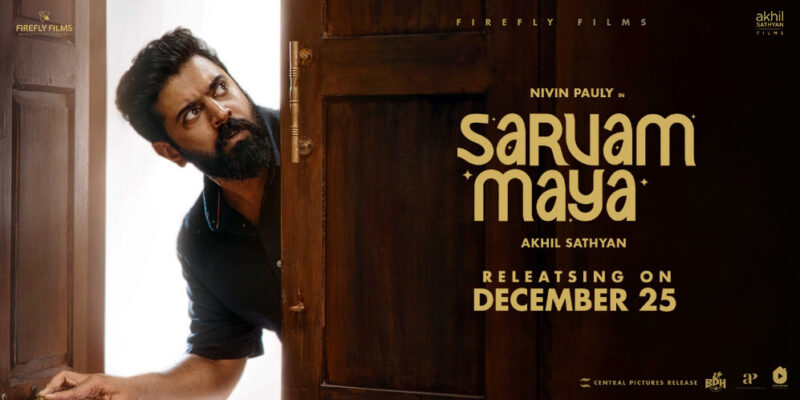
Star Cast: Nivin Pauly, Riya Shibu, Aju Varghese, Janardhanan, Preity Mukhundhan, Alphonse Puthren, Priya Prakash Varrier and Raghunath Paleri
Music Composed by Justin Prabhakaran
Cinematography by Sharan Velayudhan
Editing by Rathin Radhakrishnan and Akhil Sathyan
Directed by Akhil Sathyan
A film like Dear Zindagi [2016] had a lot to tell, but its moments did not have strong relatability except for Shah Rukh Khan’s parts and a few areas. The movie, however, has moments that could really live up to “Love You Zindagi“. But you need more than a few moments to cherish a film, and Sarvam Maya, while similarly therapeutic, stays away from lecturing and prefers to show rather than tell. While it is not a classic, it is definitely special from Nivin Pauly, as it brings back the man who made going to films joyous with his charm and innocence. Riya Shibu might just have won a few awards for her effortless portrayal. Akhil Sathyan manages to create honest moments and that’s his strength. While it has flaws, it does deliver on what it promises – “a light-hearted fun film at theatres“. Watch it and enjoy it.
That’s for those who did not watch. Please do me a favor.. watch it and come back to read further. If you don’t care for spoilers, then just trust the feeling that maybe it needs to be watched and felt, not read about before watching. So, for those who have watched, let’s share the film’s moments further – “Spoiler Alert“..
Life is like a river, no matter what stands in front of it, it’ll never stand still given enough time, it erodes those obstacles and rushes to newer grounds, carving a destiny while spreading the joy of life along its course..
Sarvam Maya is ultimately a film about the overlooked moments of life – the ones we miss when hardship clouds our perspective. It explores the paradox of shutting people out.. sometimes necessary, sometimes harmful, depending on who we choose to ignore. Yet, when genuine connections, emotions and feelings are neglected simply because they don’t serve immediate needs or stem from past mistakes, the film urges us to ask whether such rejection is deserved or whether it is, in truth, a punishment we inflict upon ourselves. The film suggests, “There is no greater tragedy than turning away from true love in pursuit of shores that offer no meaning“. Like a mirror, Sarvam Maya reflects this inner conflict, questioning self-worth and confronting self-doubt. At its heart, it is about non-physical soul connection, but equally about cultivating inner strength to overcome what suffocates us within, so that we may embrace the beauty the outside world holds.
Might sound poetic, but life is not meant to be regretted or to fill our hearts with guilt or to accept death as the ultimate solace. Just like a river, while it provides you with rich sediment deposits, it can also be the destructive force that floods and wrecks your “stable life“. Remember, even those sediments are the result of its destructive force on a massive stone, which we call a hill or a mountain, and that is the reason for its birth. When you see it that way, even “Nadiottama“, [Naditama] the mother of civilizations can be seen as a negative energy flowing through, while birth is a positive emotion. The true tragedy is not in fearing death, emotion or connection, but in losing the child-like honesty and majestic simplicity that make life profound. Whether blessed by Gods or shaped by the mysterious hand of evolution, we are here not to wait for death, but to live – fully, vulnerably, and joyously.
Akhil Sathyan tries to make this point in the most earnest possible way by making a fun ghost interact with a struggler who has great talent but misses the trigger to spark it into ignition. His problem is the blame he puts on himself and his lack of a holistic view to let bygones be bygones. He feels dejected looking at his own brother’s prosperity. If he puts his brain to it, he can conduct anything in a perfect manner and better than others, but he lacks the ability to grow beyond the issues and allow himself to be happy. He tends to call the best thing that has happened to him in his life a hallucination. He is ready to move away from it until the soul pushes him to embrace the new chapter waiting for him to open. While Nivin Pauly in this character is phenomenal and at his best as a charmer, the film is as much about him as it is about Riya Shibu, the ghost. She is not here to show how to lead life, she is here to figure out “love” as well.
She remembers only the word “Yes“, as her subconscious has lost the capacity to preserve most of her memories. That single affirmation lingers, leaving us to wonder who or what it refers to, until we realize it embodies the very definition of love itself. I recently witnessed my cousin make the most difficult decision: to let go of his mother so she could find peace and freedom from worldly struggles. Watching this film, I saw the cinematic reflection of that sentiment and was reminded of his words. Such expressions, born not of hatred or frustration but of deep, innocent love, reveal the resilience and the price that nature demands for simply “being human“. Maya is a woman who dies while chasing love, only to recognize too late that her flaw was ignoring the real love beside her, dismissing it for her illusions. Many people regret missing the chance to discover true love, but she comes to understand it after death. In embracing that love, she not only redeems herself but also helps another soul grasp its true meaning.
In her briefly but solidly narrated story, we see a stern yet loving mother who did not want heartbreak for her child. A loving, understanding father who wants to embrace life and lead it with all love and care. A brother who received great sibling energy, wishing only good for her. The person who is surrounded by such a positive world ran after her illusions and lost herself until she figured out how to love and what “Yes” she remembers means. Through this journey, she allows Nivin’s character to open himself to those who care for him, realizing that the negativity he perceives is not in the world around him but within himself. Even his cousin, who once sought to exploit his talent for money, ultimately repays him with gratitude when he takes a bold step toward his goals. And then comes the father’s scene and the final confrontation – moments that demand to be experienced in the theatre, where writing, staging, acting and pacing converge in perfect harmony. The final confrontation brings a beautiful close, layered with the mother’s grief: she believed her daughter was never truly loved back and mourned as she died chasing a man who lacked empathy for her love. Nivin Pauly’s visit grants her the closure she longed for, while her father and brother carry the pain of losing her. The mother’s refusal to let go of her harsh feelings toward someone she had never even met makes her eventual release all the more poignant – a deeply poetic closure that ties the film’s emotional threads together.
While Sarvam Maya is a decent film, its flaws lie in moments that drag to accommodate extra “funny” scenes. It lacks a true laugh-out-loud segment, though its honesty provides occasional bursts of humor that keep it engaging. The staging shines in places like the accident sequence, the father’s scene and especially the final confrontation scene – though a few moments feel jarring. Preity Mukundhan’s character is too underwritten, while a few of Aju Varghese’s moments appear slightly repetitive. The reliance on cliches occasionally hinders the narrative, but when the film delivers, it truly hits the ball out of the park. Technically, the production values are strong and Justin Prabhakaran’s music elevates the film to another level. His songs resonate beautifully on screen, complemented by effective sound design. Overall, Sarvam Maya starts off like a river in the mountains but slowly grows into the widest possible one, expanding into larger territories that become fertile fields. Well, it asks people: why not just see the glass “Half Full” when you can easily say “Half Empty,” which will only lead to “Full Empty”.
Theatrical Trailer:
Recent Comments