Tere Ishk Mein: Eclectic and Monolithic Lives
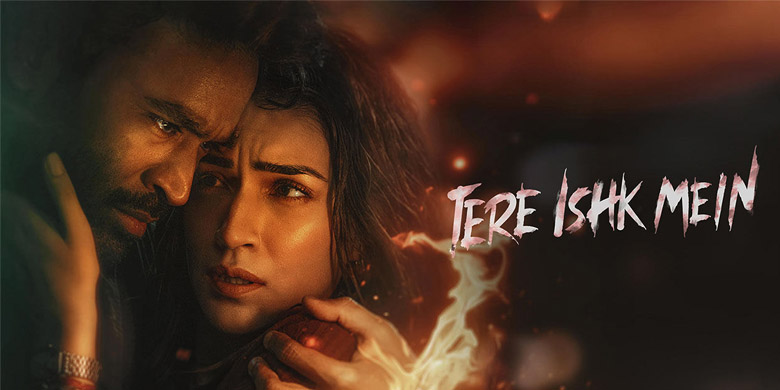
Star Cast: Dhanush, Kriti Sanon, Prakash Raj, Priyanshu Painyuli, and Mohammed Zeeshan Ayyub
Music Composed by A.R. Rahman
Cinematography by Tushar Kanti Ray
Edited by Hemal Kothari
Directed by Aanand L. Rai
You always feel the loss more deeply than you appreciate being loved…
This quote is a direct reference to the lives of many people around us, as their experiences with love and life in general speak of the time they miss and love to preserve. This is a common feeling for many, but when you see a film like Tere Ishk Mein, you tend to understand the gravity of the extremes that such a loss can take you to. The story is not about people with normal lives like Raanjhanaa [2013]. It features two characters whose aspirations changed over time as love broke them into pieces. One was consumed by it, and the other wanted destruction and revenge. So, what about the sequel? Well, when two people who can only attract destruction walk into each other’s path, they tend to repel like positively charged magnetic poles, leaving their signature of unlovable lives. In short, before diving into spoilers, watch the movie for what it stands for and not just what it appears to showcase. Please watch the movie and read the rest of the analysis.
Shankar ko Mukti tabhi milegi jab hum bolenge..
When you look at the story of Lord Shiva and Sati Devi, their love was destined to be destructive. Well, even as Parvati, she faced a lot of objections, but this time from the ultimate God himself. Shiva was eager to fall in love with Sati, but her beauty, her soul, her penchant for staying in love, and her innocence made him fall for her. While he knew his destiny, he could do nothing but fall in love and then become so destructive that Lord Vishnu had to interfere and change the course of the lost wanderer. Was he lost in love? Was he mad? Was he ungrateful? Did he just not care? He felt all the emotions, he was the ultimate God, but love consumed him so much, and the injustice against the innocent made him so angry that he chose self-destruction, which in turn destroyed the Universe. Where did he find his Mukti then? In the touch of a friend like Vishnu, who guided him to the path of finding himself again, which led to a happy family with Parvati. For this Shankar, only death brought him “Mukti”. Life leads to your ultimate goal they say, and for Shankar that proved to be the absolute truth, metaphorically, as he kept chasing Niravana, which doesn’t grant itself easily and hence he found it in death. In Ranjhaanaa, it was about first love, here it is about the last.
Don’t get consumed in yourself that you inflict irrevocable damage..
Self-love is a great term that is being promoted and it must gain such prominence but not at the cost of love itself. You can see the extreme destruction that Mukti’s self-love has led to. She could not accept the fact that her “research” is flawed and there is no proof that “violence” can be cut off like a branch from a tree, as it’s more deeply rooted, which can only be plucked out or planted in another area with love. When Shankar says, “I always feel I’m burning and cannot escape it“, we understand where the root cause of his hate lies and where his insecurities stem from. He never got the love he desired and took the love that was available in his life for granted. He is the opposite of self-love, he is always on the path of self-destruction. But Mukti, who also lost her mother, is trying to create a world that she aspires for herself, but not one that people think is possible, not even her father, who in fact needs more compassion as an IAS officer and Joint Secretary. For her, life is easy and there is no wrong in taking that extra step toward achieving what she aspires. There is no problem with being selfish and motivated by big dreams, but she thinks it is a noble deed. She is accomplishing nothing selfless, but she thinks she is, and that’s the issue.
Duality lies in emotions and the Universe acknowledges it.
Ever have you felt sad one hour ago and happy the next? Ever have you experienced that your heart burns at the thought of a person but then felt happy with the same memories that you both share? Destruction and creation go hand in hand. If there is no Shiva, then there is no work for Brahma, and if there is no Vishnu, there is no work for both. Vishnu acknowledges Brahma and Shiva and never tries to fight for supremacy. The Universe needs that balance, and so does our human body. You cannot always be happy, and you cannot always be sad. Shankar tries to find his happiness in being fulfilled by love but gets dragged further into soul-searching, where he meets a void. Mukti has everything, and in a snap she loses it all, as she always started with void in thoughts, void in actions, and void in beliefs. Shankar is open about his void and wants an escape. Hence, he is happier to destruct so that everything is filled with the same nothingness. Mukti wants what she needs and lacks the insight to understand interior depth, as ulterior motives seem perfect. Still, she is being dragged into a void.
Anand L. Rai captures this with aplomb, accuracy and a great eye for detail. It is cut between two contrasting emotions, which appear different but project similar ones in many places. It is seamlessly shot and edited to perfection. See the way he cuts between Prakash Raj’s death and Mukti’s marriage preparations, the way she is speaking in awe of him while he is burning inside as she chose someone else over him. She feels discomfort in his house and we see him trying to be comfortable at her place. We see the pyre and then the entry of Raanjhanaa Pandit, asking him to just die again. This is a soul connection of unrequited love: a young boy who walked past in Shankar’s attire in the first one seems to have found a similar destiny. You can call it a reflective emotion of one man unable to find love, his burning desire being passed on to the “Shankar” and hence he wants to burn the hell out of everything, still no “Mukti” for him from all of it. It feels like destiny asking him to accept its apology and pass on to another soul for maybe a third chance at all of it.
Everything happens for the greater good…
Really though? Mukti is running away from the fascination that she has for Shankar and he is running away from everything that never really defined him. Who he truly is remains a mystery to him, and who she really turned out to be suffocates her. He can only die or kill, as he is Rudra, and she can only offer nothingness, as she is “Mukti”. When you’re attracted to nothingness, what many state as the “ultimate reality” and limbo that only God can offer, that is the idea of “Mukti” in our beliefs: you can only die to attain it. In their destruction, they both still give way to positive forces to survive as their “loving remains”. Well, the problem in this story lies in trying to give a definition to the spiritual theme of attaining Mukti through human emotions. There is a limit to understanding within a human body, and trying to push it requires a similar amount of preparation. Shankar is not just stubborn and reactive, he is bull-headed in taking decisions and unaware of others feelings. So is Mukti. You’re left as a viewer just not connecting with both of them because they are not fun enough. They are too scary, extreme characters for an audience member to identify with. The way they speak in metaphors and the kind of emotions they exhibit feels too constructed, too perfect, and too tight, so that even a small disturbance can result in a collapse. Hence, Tere Ishk Mein feels like a problematic film with flawed representation but great execution.
Anand L. Rai gave a challenge to A. R. Rahman and the composer brought out his best. It is not a regular film and hence he did a splendid job in creating great sound for it. Rahman’s music and Irshad Kamil’s poetry breathe life into the film, charting love’s journey from its fragile beginnings to its inevitable heartbreak. Their work paints not just the sweetness of desire but the wreckage left when it collapses. The soundtrack pulses with raw feeling, carrying the story forward and laying bare Shankar’s descent into turmoil with an intensity that lingers long after the scene fades. Performance wise, Dhanush is yet again wonderful, with Kriti Sanon giving her best. Editing, writing, and execution all sit well, but writing again falls short in conveying the emotions as intended. As the characters are both at extreme peaks, the problem that we saw in Tamasha is doubled. Rather than feeling empathy or sympathy, we just tend to look at it almost as a well executed docu-drama and that is the perfect way we can describe it. While it works to a major extent, as we lack the emotional connectivity, we end up leaving with the same voidness that Shankar had to offer and Mukti promises. There is no silver lining except for a filmmaker’s ambition and conviction. Tere Ishk Mein deserves to be watched, as every craft surrendered to that conviction, and yet it should not be taken seriously, as it just talks about only two characters and not the universe. Like a paradox representing an eclectic collection of emotions in monolithic lives, Tere Ishk Mein works as a film that deserves not to be ignored at all, yet it wants to be a standalone piece in solitude so strongly that we fear falling in love with it.
Theatrical Trailer:
Shee the movie